

The Odd Nepo Kid

To be honest, I never thought I would see Karuppu in theatres, much less that it would revive the career of Suriya Sivakumar and bring the king back to his throne. While the likes of Ananya Panday, Janhvi Kapoor, and Arjun Kapoor are often criticized as products of nepotism, South Indian actors like Vijay, Jiiva, and Suriya proved to be the exact opposite.
Yes, their fathers’ clout or industry connections gave them an initial breakthrough, but what made them survive was their sheer talent and hard work. Among them all, Suriya had the most strenuous and challenging journey.
He initially worked in a garment factory, withholding his real identity and travelling 50 km back and forth to build his own life. Even his father, the veteran actor Sivakumar, admitted in an interview that he never thought Suriya would become an actor because he was too mild and avoided eye contact.
These traits came to plague him post-debut. Suriya got a rare opportunity to star in his first movie, Nerrukku Ner, produced by veteran director Mani Ratnam. He played the second lead, and despite the movie’s commercial success, his acting and dancing skills were heavily criticized by both audiences and critics.
The screen name “Suriya” was suggested by Mani Ratnam himself to avoid confusion with another actor named Saravanan. It was a character name popular in Ratnam’s filmography, and that is how Saravanan transformed into Suriya.
In Tamil cinema, a hero is traditionally expected to be an all-rounder—someone who can dance, fight, and deliver perfect lip-syncing. Essentially, they must be a man of the masses, which remains the defining line between an actor and a star.
The ones who cracked that formula live rent-free in the hearts of millions, with Rajinikanth and Vijay being prime examples.
During this formative period, his mentor, the late veteran actor Raghuvaran, advised him to carve out his own identity rather than trying to fit into his father’s mold. That advice shaped his trajectory in the years to come.

The Rise of Suriya Sivakumar
Suriya delivered a resounding response to his detractors through a powerful comeback in director Bala’s Nandha. It marked a complete makeover for the actor; there was no trace of the boy-next-door from Nerrukku Ner. In his place stood a man with an incredibly intense gaze.
From the very first scene, his character haunted viewers—a young man who committed patricide to protect his mother, only to be cursed by her for life. This was followed by Pithamagan, a film where Suriya matched strides with Vikram, playing a charismatic village con man.
Like most of Bala’s works, the film was deeply moving, culminating in a heartbreaking climax. The raw emotion of those early onscreen roles remains memorable to this day.
During this era, he won his first Tamil Nadu State Film Award for Best Actor for Nandha alongside his first Filmfare nomination. He then delivered a breezy performance in Unnai Ninaitha opposite Sneha, playing what modern audiences would call the ultimate “green flag.” In stark contrast, Mounam Pesiyathe saw him portray an aloof youth with absolutely no romantic inclinations.
An intense outcast, a gentle lover, and a cynical youth—all within a short span. From that point on, there was no looking back for the Nadhigin Nayagan.


The Actor Who Refused to Stop Experimenting
Post-Kamal Haasan, the Tamil film industry had a void. While many stars delivered massive blockbusters, most preferred staying within their comfort zones playing larger-than-life characters. Suriya, however, chose a different path.
He treated every project as a new challenge. In Perazhagan, he played a dual role as a hunchback and a fiery boxer; soon after, he transformed into a fierce, no-nonsense cop in Singam. He simply refused to stop innovating.
Through these versatile performances, he left his mark on an industry that had once mocked him, evolving into one of those rare stars championed by critics and mainstream audiences alike.
His status as a generational talent was cemented by performances like the amnesiac business tycoon in Ghajini and his dual portrayal of an endearing father and son in Gautham Vasudev Menon’s masterpiece, Vaaranam Aayiram.
While many actors have tackled double roles, Suriya brought an unparalleled emotional depth to this father-son dynamic. Vaaranam Aayiram took an entire generation on an emotional roller coaster, offering profound lessons on love, grief, and family. Suriya didn’t just act; he lived the role.

The Lows and Slow Erosion of Fame
Every superstar faces a slump, and after a decade of golden success, Suriya encountered his. The shift began with his second collaboration with director K.V. Anand, Maattrraan. This stood in sharp contrast to their previous blockbuster Ayan, which remains one of the most celebrated action-entertainers in Tamil cinema.
Despite addressing a unique, socially relevant topic laced with an intriguing plot, the film opened to mixed reviews and failed to resonate deeply with audiences. A string of subsequent projects met a similar lukewarm fate.
Suriya had become an actor capable of carrying an entire film on his shoulders. However, this became a double-edged sword. Mediocre scripts with one-dimensional supporting characters relied solely on his star power to fill the gaps, and eventually, that weight became too heavy to bear.
Yet, even during this rough patch, his experimental spirit never died. This persistence struck gold with 24, a sci-fi thriller helmed by Telugu director Vikram Kumar.
Playing a triple role as the hero, the nephew, and the villain, Suriya was phenomenal. While his romantic avatar faced minor criticism for a repetitive catchphrase (“I am a watch mechanic”), his portrayal of the antagonist, Athreya, introduced a chilling new dimension to his filmography.
Known as one of the kindest gentlemen in the industry, Suriya transformed into one of Tamil cinema’s most sinister villains. Athreya possessed a rare blend of ruthless nastiness and magnetic charisma that made him absolutely unforgettable.
While the third installment of the Singam franchise managed to enter the 100-crore club, the formula had clearly run its course, and the mass-masala flavor was losing its edge.
Collaborations with contemporary directors like Vignesh Shivan (Thaanaa Serndha Koottam) failed to make a lasting impact with a wider audience. As a new wave of young talent emerged, Suriya temporarily lost his hold on the box-office throne.


The OTT Gamble and Show Stealing
During the COVID-19 pandemic, when theatres were shut down worldwide, Suriya took a massive gamble by striking a multi-film deal with Amazon Prime Video to release two of the most ambitious projects of his career directly on OTT.
Both films were based on real-life figures and shattered language barriers to become global streaming sensations, reaching audiences far beyond the traditional diaspora.
Soorarai Pottru earned Suriya his first National Film Award for Best Actor. The film became a massive critical success and even entered the race for the 93rd Academy Awards.
Portraying Maara, a character inspired by Air Deccan founder Captain G. R. Gopinath, Suriya delivered a masterclass. The movie’s immersive storytelling offered a more raw, visceral look into business pitching and resilience than a typical MBA degree ever could. It was so emotionally heavy that its defining moments remain permanently etched in memory.
He followed this up with Jai Bhim, portraying the real-life advocate Justice K. Chandru. The film exposed the horrifying institutional bias and custodial torture faced by the marginalized Irular tribe. Though it featured standout performances from Lijomol Jose and Manikandan, Suriya’s restrained portrayal of Chandru underscored the true power of constitutional law for the common man.
Even when the narrative made you lose faith in humanity, Chandru’s unyielding stance kept it alive. The iconic final scene—where he casually nods at a young tribal girl, empowering her to sit comfortably with her legs crossed—was a pure cinematic moment that deserved the loudest theatrical cheers.
These back-to-back triumphs brought Suriya immense global recognition, culminating in an invitation to join the Academy of Motion Picture Arts and Sciences (the Oscars).
Despite this critical high, his return to theatres with Sun Pictures’ Etharkkum Thunindhavan met with mixed reviews and failed to live up to the massive expectations.
But then came the ultimate shockwave: his brief, breathtaking cameo as the ruthless cartel kingpin Rolex in Lokesh Kanagaraj’s Vikram. Sharing a universe with legends like Kamal Haasan, Fahadh Faasil, and Vijay Sethupathi, Suriya completely stole the show.
In just five minutes on screen, he dominated the frame, sparking a nationwide craze for a standalone Rolex movie. His unhinged, charismatic swag was a revelation. If Athreya was a precise German pistol, Rolex was a fully loaded machine gun—vicious, unpredictable, and loud.

The Siva and Retro Effect
The momentum hit a major roadblock when he collaborated with director Siva for the fantasy epic Kanguva. While the initial announcement of a period-fantasy film was intriguing, doubts lingered about whether a director known for melodramatic family dramas could pull off a gritty historical canvas.
Aggressive marketing pushed it as a pan-Indian milestone, with producers boldly claiming it would cross ₹2,000 crores to challenge records set by Dangal and Baahubali.
Needing to cross ₹500 crores just to break even, the film tanked, barely scratching ₹150 crores. While Suriya delivered an intensely physical performance as the tribal chieftain, his modern-day counterpart, Francis, felt entirely out of place.
Despite boasting names like Bobby Deol and Disha Patani, the narrative fell completely flat. To make matters worse, the audio track was heavily criticized for being deafeningly loud. Even the CGI, which reportedly consumed a massive chunk of the budget, looked unpolished and subpar.
It went down as one of the biggest disasters in Tamil film trade history, a commercial misfire rivaled only by Indian 2 later that year.
Suriya faced heavy mockery from rival fan camps, as even his earnest performance couldn’t save a flat screenplay. Then came Retro.
Retro was highly anticipated as a signature Karthik Subbaraj spectacle (sambavam) meant to revive Suriya’s theatrical box-office pull. Having previously orchestrated Rajinikanth’s grand resurgence in Petta, Subbaraj seemed like the perfect director for the job.
For many fans, the film hit the right notes. It featured Suriya in a stylish, fresh avatar, with Subbaraj effectively weaving a compelling character study through the eyes of the protagonist, Paari.
Marketed with the tagline “Love, Laughter, and War,” the film received vastly superior critical reception compared to Kanguva. However, despite the widespread goodwill and positive reviews, the critical praise failed to fully translate into major theatrical footfalls.
As a result, the film barely touched the ₹100-crore mark. Nonetheless, Suriya slid into the role of Paari with effortless grace, excelling in both high-octane action sequences and stone-cold dialogues. Intriguingly, while Suriya is celebrated for his warm onscreen smile, Paari was written as a stoic man who views himself as a demon incapable of laughter.
Had the narrative structure balanced its themes more tightly, the emotional payoff would have been greater. While the final act attempted to use laughter as a profound metaphor against oppression, it felt slightly disconnected for the average theatregoer.


The Karuppu
Then came Karuppu. Following the underwhelming responses to his recent commercial ventures, I entered the theatre with minimal expectations. The trailer hinted at a standard “man-as-god” template common to early 2000s Tamil cinema.
The premise seemed straightforward: RJ Balaji plays the calculating antagonist, and Suriya portrays a divine incarnation sent to halt his schemes. Usually, such films lack real tension because the protagonist is omnipotent, relying on predictable hurdles or a larger-than-life rival demon to create conflict.
However, Karuppu defied these tropes. Despite being a star-driven film, Suriya doesn’t make an entrance until 40 minutes in. Instead, the narrative is anchored by veteran Malayalam actor Indrans and Anagha, whose innocent performances form the true heart and soul of the film.
Audiences immediately related to their plight, feeling the genuine pain of common citizens navigating a broken legal system. The primary source of entertainment came from RJ Balaji’s character; while he lacked the chilling smoothness of a Fahadh Faasil or the theatrical cunning of an S.J. Suryah, that was exactly the point. He was a deceptively ordinary antagonist.
Witty and charismatic, he effortlessly gains people’s trust. In an ingenious twist, he forces a deity into a legal corner, challenging the local guardian deity Karuppaswamy (Suriya) to seek justice within a court of law while binding him to a promise not to use his divine powers.
This creates an engaging “Thor and Loki” dynamic where a god is stripped of his supernatural elements. While the film has minor narrative flaws, it never pretends to be anything other than what it is: a highly entertaining commercial entertainer for the masses.
RJ Balaji is well known for blending social commentary with his signature wit, but few expected him to successfully helm a high-octane mass masala film.
Yet, against all odds, he delivered a quintessential star vehicle. The film faced a last-minute hurdle when its release day was stalled due to financial disputes involving the producers, prompting Suriya to personally step in and resolve the issue.
When I first watched it at a local multiplex, it was relegated to the smallest screen with no opening-day celebrations or fan frenzy.
Disheartened by the sudden release delays, many fans had already initiated ticket refunds. However, the tide turned dramatically over the weekend.
The film is currently on a triumphant theatrical run, comfortably crossing the ₹300-crore mark at the box office. While some have dubbed it Suriya’s version of an unhinged entertainer, it functions more like a definitive career comeback. The script is packed with self-aware easter eggs, some of which lightheartedly poke fun at the director and the star himself.
For instance, a scene where Karuppaswamy jokingly asks Balaji’s character about tickets for Mookuthi Amman serves as a playful retaliation to a famous dig Balaji took at Suriya’s Anjaan years ago in Naanum Rowdy Dhaan.
There is also a brilliant nod to Lokesh Kanagaraj’s Leo, featuring a sequence where a coffee shop confrontation is deftly defused before escalating into violence.
Ultimately, the film allowed Suriya to fully unleash his intensity while having genuine fun on screen. His transition into the fierce guardian deity during the interval block was spectacular enough to warrant a second theatre visit just to join in on the roaring cheers.
As a cinephile, I am eagerly looking forward to Suriya’s upcoming lineup, including his collaboration with Venky Atluri on Vaathiyar (or Vishwanath & Sons) and the highly anticipated Galatta, helmed by Aavesham fame Jithu Madhavan.
At the end of the day, it is not just about capturing box-office milestones or reclaiming crowns. Cinema is defined by its unique capacity to make people feel and deeply resonate with a story. Among all art forms, film holds this singular magic—and that is exactly why we celebrate our reel heroes in the real world.
Explore the Mythology of Karuppaswamy
Complete your reading journey. Enter the catchphrase GOD MODE Below for some peak into the myth of Karuppaswamy
Karuppaswamy
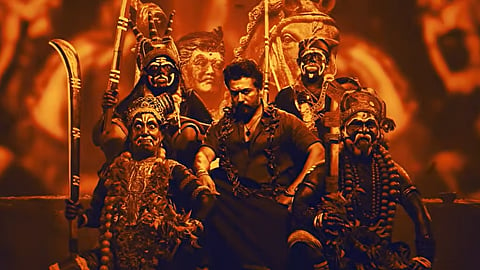
Unlike mainstream Brahmanical deities such as the Trimurti (Brahma, Vishnu, and Shiva), folk deities like Karuppaswamy are deeply tied to specific regions or villages. While the major gods manage cosmic threats, these guardian deities resolve local grievances, acting like the friendly neighborhood protectors of the pantheon.
In local folklore, he is revered as the ultimate protector of the innocent. Characterized by his dark complexion—hence the name Karuppaswamy (the Dark Lord)—he is traditionally depicted riding a white horse, delivering swift divine retribution to wrongdoers regardless of their social status.
Different Origins
According to certain regional variants of Hindu lore, his lineage is linked to the Ramayana. The myth states that Sage Valmiki created a child from holy grass when he mistakenly believed Sita had lost her son, Lava. When Lava returned safely, the sage realized his mistake, and Sita chose to raise both boys as brothers.
When the brothers were later accepted by Rama, they underwent a trial by fire. While Lava walked through unscathed, the brother born of the grass emerged physically unharmed but with skin turned as dark as charcoal. Recognizing the boy’s unique destiny, Rama blessed him with divine weaponry and sent him south to guard mankind during the age of Kali Yuga.
Alternatively, in historical traditions associated with Ayyappa or Ayyanar, Karuppaswamy is described as a fierce warrior sent by Shiva to protect the divine Hariharaputra during his journey through the wilderness to defeat the demoness Mahishi. Once that divine purpose was fulfilled, he took up residence as a sentinel alongside the sacred 18 steps at Sabarimala.
From a historical perspective, Sangam literature scholars trace the origin of Karuppaswamy back to the ancient practice of hero-worship (Hero Stones or Veera Kal). These stones were erected to honor local chiefs or warriors who died defending their community, livestock, or land from bandits and invaders. Over generations, these mortal heroes transitioned into folklore, eventually rising to divine status in folk religion.
Discover more from Ivide LIVE
Subscribe to get the latest posts sent to your email.


